
Week 6 — Identity as Technology
The architecture that makes participation possible.

“The conscious feeling of having a personal identity is based on the perception of the selfsameness and continuity of one’s existence.”
Erik H. Erikson, Identity: Youth and Crisis“The self is something which has a development; it is not initially there, at birth, but arises in the process of social experience.”
George Herbert Mead, Mind, Self, and Society“A man’s Self is the sum total of all that he can call his.”
William James, The Principles of Psychology“Character is centrality, the impossibility of being displaced or overset.”
Ralph Waldo Emerson, “Character”“Religion is not the longing for self-annihilation, but for self-completion; it is the longing not for death but for life.”
Miguel de Unamuno, The Tragic Sense of Life
You wake up in the morning and know who you are.
Before you speak, before you remember the day’s obligations, before anyone says your name, there is already a quiet continuity in place. You recognize the room. You recognize your body. You recognize the life you are returning to.
There may be tension in that life. There may be confusion. Parts of you may be changing faster than others. Still, something persists.
You remain recognizably yourself.
We usually take this for granted.
Identity feels less like a structure we are using and more like the simple fact of who we are. It seems to be the thread running through childhood, adolescence, work, relationships, grief, belief, and change. The details evolve, but the person remains.
Until enough pressure arrives.
A relationship ends. A role disappears. A belief that once organized the world no longer holds. The community that gave you belonging begins to feel too small. A spiritual experience opens something your previous identity cannot explain. A body changes. A child leaves. A career ends. A truth you have avoided becomes impossible to keep outside awareness.
Then the thread becomes visible.
You may find yourself asking questions that once seemed unnecessary.
Who am I if I am no longer this? What remains when the role is gone? Why does one change feel manageable while another seems to threaten the whole structure? What exactly is identity doing when it holds, and what happens when it no longer can?
These questions become clearer when identity is understood as architecture.
Architecture gives form to movement. It creates continuity across rooms, thresholds, levels, and changing conditions. A building is not simply a collection of materials. Its structure determines what can happen inside it, how much pressure it can bear, where movement is possible, and what must remain connected for the whole to function.
Identity works in a similar way.
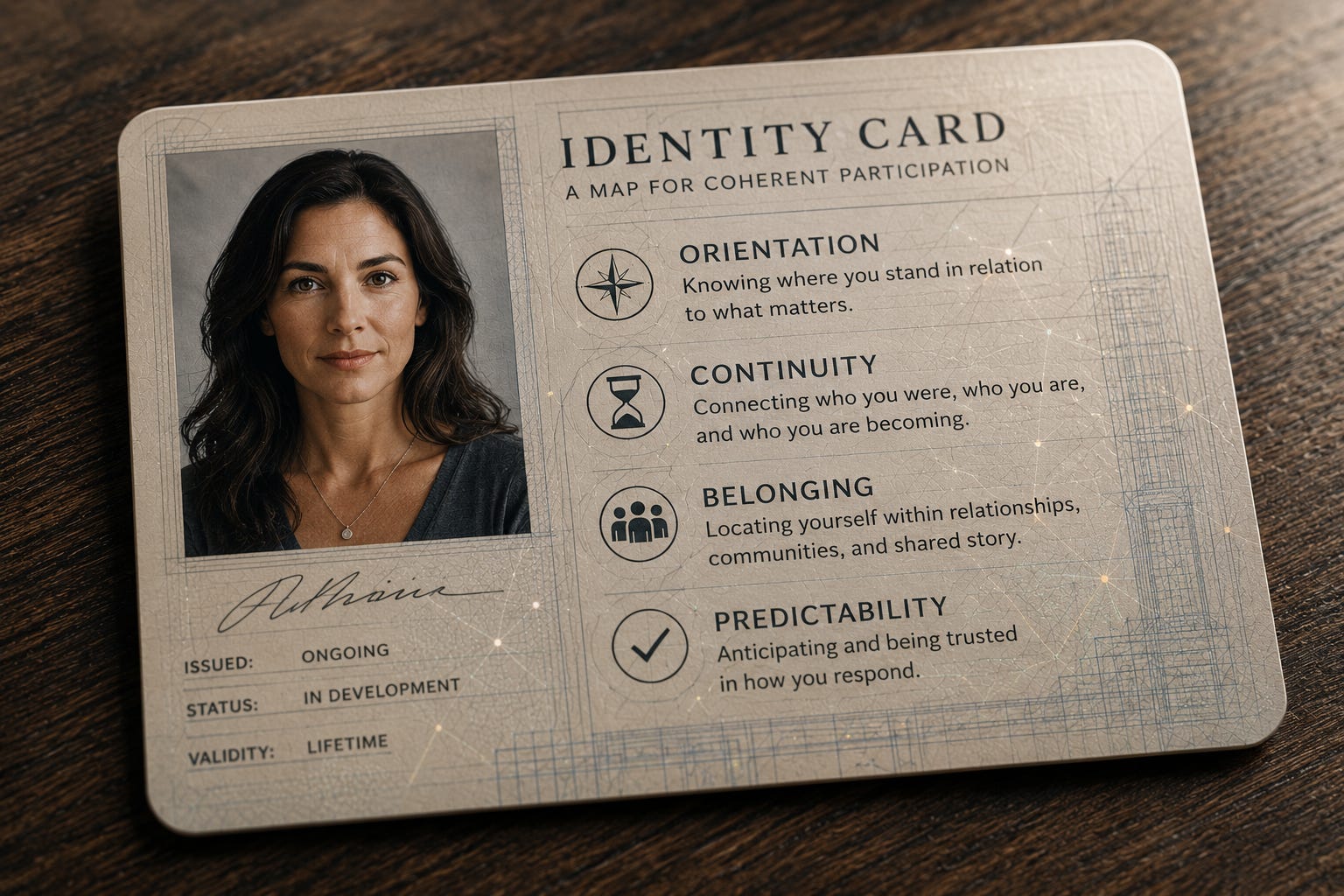
It organizes experience into a livable form. It gathers memory, value, relationship, role, expectation, and meaning into a structure coherent enough for a person to participate in life. It tells you where you are, what matters, who belongs to your world, and how the person you were yesterday connects with the person making decisions today.
This structure is real. Its reality does not require it to be permanent or ultimate. A bridge is real because it carries weight. A language is real because it allows meaning to move between people. Identity is real because it performs essential functions.
The first is orientation.
Orientation
Identity helps you know where you stand in relation to what matters. You know which commitments are yours. You know what kinds of behavior feel congruent with the person you understand yourself to be. You know which responsibilities belong to you and which do not. You know what you are moving toward, what you are protecting, and what you are unwilling to abandon.
This orientation is rarely complete or perfectly accurate. It changes across context. A person may feel clear in their work and uncertain in intimacy. They may know who they are within a family and become disoriented when they enter a new community. Even so, some degree of orientation is necessary. Without it, every decision begins from the beginning. Every demand carries equal weight. Every environment has the power to define you.
The second function is continuity.
Continuity
Identity connects experience across time. You can remember the child you were, recognize the adult you became, and experience both as belonging to one life. You can make a promise today because you expect some recognizable version of you to exist tomorrow. You can learn from the past because the person who made the mistake and the person reflecting on it remain connected.
Continuity does not mean sameness. You can change your beliefs, values, relationships, language, and way of participating while remaining aware that the change happened to you. Identity allows transformation to occur without every transformation feeling like total annihilation.
The third function is belonging.
Belonging
Identity locates you within relationship. You belong to families, friendships, communities, traditions, professions, places, and histories. These forms of belonging do more than describe social membership. They provide context — telling you which stories precede you, which obligations you have inherited, which forms of recognition are available, and where your participation is expected.
Belonging also regulates experience. A person often knows more clearly who they are when they are with people who recognize them accurately. In other settings, they may contract, perform, defend, or become uncertain. This does not mean their identity is false. It shows that identity is relationally supported and context-sensitive.
The fourth function is predictability.
Predictability
Identity allows both you and others to anticipate how you are likely to respond. You know something about your own thresholds, patterns, loyalties, fears, and capacities. The people around you know something about what they can expect. This makes trust, cooperation, planning, accountability, and sustained relationship possible. Enough continuity for trust, enough flexibility for development — that is what functional identity maintains.
Together, orientation, continuity, belonging, and predictability form a regulatory structure. Like any load-bearing architecture, its function becomes most visible not when conditions are comfortable but when weight is applied.
This is why identity becomes so visible under pressure.
When conditions are familiar, the architecture may seem effortless. The roles fit. The values hold. The relationships reinforce the existing structure. You know what is expected and how to respond.
Pressure reveals the load-bearing parts.
Relational conflict may challenge belonging. A major transition may interrupt continuity. Moral complexity may destabilize orientation. An unfamiliar response from your own body or emotions may disrupt predictability. The resulting distress can feel larger than the immediate event because the event is pressing against the structure through which the rest of life is organized.
This connects directly to the question of regulation we explored in Week 4. Identity is one of the structures involved in integrating expanded awareness. It helps widened experience become part of a continuous life rather than an isolated rupture. When identity is too rigid, new experience is filtered out because it threatens the existing architecture. When identity becomes too diffuse, the person may lose the continuity needed to metabolize change.
A functional identity must be stable enough to maintain connection and flexible enough to reorganize.
That balance is rarely uniform. A person may be able to reconsider a professional identity while feeling deeply threatened by a change in family role. They may remain flexible in intellectual questions and become rigid when belonging is at stake. Identity is therefore better understood as a living architecture than as a fixed possession — strengthening through use, reorganizing when conditions change, sometimes preserving patterns long after those patterns have stopped serving the larger system.
This reframe changes the developmental question.
When identity is treated as essence, every challenge can feel existential. If the structure changes, it may seem that the self is being lost. When identity is understood as architecture, change can be approached with greater precision. Which part of the structure is under pressure? What function is being threatened? Is the person losing orientation, continuity, belonging, or predictability? What needs to remain connected while something else changes?
These questions reduce confusion because they reveal that identity strain is often functional before it is philosophical.
Consider what this looks like in practice. A person may say “I don’t know who I am anymore” when the community that once reflected them has disappeared, a rupture in belonging presenting as an existential crisis. But the same words carry a different weight for someone who has touched a profound experience and cannot reconcile what they have seen with the life they were already living. The sentence is identical. The architecture affected is different. And the path forward depends on which function is carrying the pressure.
This understanding also protects against a common spiritual mistake.
Attempts to dissolve identity entirely often overlook what identity makes possible. Human life requires boundaries, continuity, responsibility, discernment, and role. A person still has to answer to a name, care for a body, keep commitments, navigate consequences, and participate in relationships where their actions matter.
Expanded awareness does not remove these requirements. It increases the need for an identity capable of holding them without becoming closed around them.
Identity is a participation technology.
It is the structure through which a human being enters sustained relationship with the complexity of life. Individuation — the process of becoming a distinct, differentiated self — is not the opposite of connection. It is what makes genuine connection possible. To be someone is to exclude countless other possible forms in any given moment. It is to inherit a history, occupy a body, encounter limits, and become accountable for a particular pattern of participation. That cost is also what makes contribution possible. A person without a standpoint cannot enter relationship from anywhere. A person without continuity cannot sustain a promise. A person without enough predictability cannot become trustworthy.
Identity makes individuation usable.
It gives life a form through which it can participate.
The work, then, is neither to defend identity as the final truth of what we are nor to treat it as an error that spiritual development must erase. The work is to develop identity into a structure capable of stewardship — maintaining continuity while remaining open to correction, receiving influence without collapsing into imitation, preserving boundaries without turning them into walls, belonging without demanding sameness, changing without treating every change as death.
This is where the Divine Ideal from Week 5 becomes practical.
An identity does not reorganize in a vacuum. It develops in relation to what it is oriented toward. Truth challenges distortion. Life challenges structures that have stopped responding. Beauty challenges forms that no longer express the quality of participation they were built to serve. The ideal provides direction. Identity gives that direction a human form.
Yet even this does not happen alone.
No identity develops in isolation. Our earliest sense of self forms through response, recognition, touch, language, boundary, and relationship. We learn what can be expressed by discovering what the people around us can receive. We learn continuity through being remembered. We learn belonging through participation. We learn predictability through the repeated patterns of interaction that tell us what happens when we reach, speak, withdraw, fail, or return.
The architecture of identity is built between people as much as within them.
That leaves us with the next question.
If identity is the structure through which we participate, and if that structure is formed and maintained relationally, then how much of what we call personal coherence has ever been personal alone?
That is where the next part of this series begins.
A Note on How This Article Was Developed
This article was proudly developed through a Coherence Loop with artificial intelligence. AI helped expand the field of possibilities, test connections, challenge assumptions, and refine the language. The discernment remained mine.
The final structure, meaning, and conclusions reflect my lived experience, judgment, and responsibility as the author. Generation was collaborative. Discernment was human. Authorship lives in that discernment.