
Spiritual Technology
A Prologue

Thomas Troward
“By adhering to a definite principle we shall find that it will open out, and lead us on into continually increasing discoveries of our own powers and of the boundless possibilities which are latent in the Infinite.”
Albert Einstein
“The important thing is not to stop questioning. Curiosity has its own reason for existing.”
Werner Heisenberg
“What we observe is not nature itself, but nature exposed to our method of questioning.”
Richard Feynman
“The first principle is that you must not fool yourself—and you are the easiest person to fool.”
Consider what happened the first time someone noticed that a curved piece of wood, released at the right angle, would return to the hand that threw it.
That moment was more than practical. It was scientific. Someone had observed something true about the way reality behaves — about force, angle, and return — and then learned to work with it intentionally. The tool that followed was not magic. It was the application of a discovered principle.
That is how every meaningful technology begins.
Not with invention. With understanding.
The understanding always comes first. Someone notices a pattern in the way reality behaves. They test it, refine it, and eventually learn to work with it deliberately. What follows — the bridge, the engine, the circuit — is not the discovery itself. It is what becomes possible once the discovery has been made.
Before there could be bridges, there had to be an understanding of forces and materials. Before there could be flight, there had to be aerodynamics. Before there could be computers, there had to be mathematics and electronics.
Science asks a simple question: how does reality work? Technology asks a different one: given those principles, what becomes possible?
Science discovers.
Technology applies.
Every meaningful technology begins with a deeper understanding of reality itself.
But what if the same pattern exists somewhere else?
For thousands of years, human beings have explored territories that no telescope or microscope could reach.
Attention.
Identity.
Relationship.
Meaning.
Consciousness.
These are not marginal concerns. They are the territories in which human beings actually live — where suffering arises and where it resolves, where capacity either develops or collapses, where the quality of a life is ultimately determined. Every civilization has known this. Every culture in recorded history has invested at least some effort in understanding these domains and cultivating the capacities they require. Some cultures immersed themselves in the journey.
They built practices, disciplines, communities, rituals, contemplative methods, and entire ways of living intended to transform how human beings experience themselves and the world.
We have usually called those efforts spirituality, religion, philosophy, or mysticism.
What we have rarely called them is technology.
That may be because we have rarely considered whether they were built upon discoverable principles.
What if there is a science here?
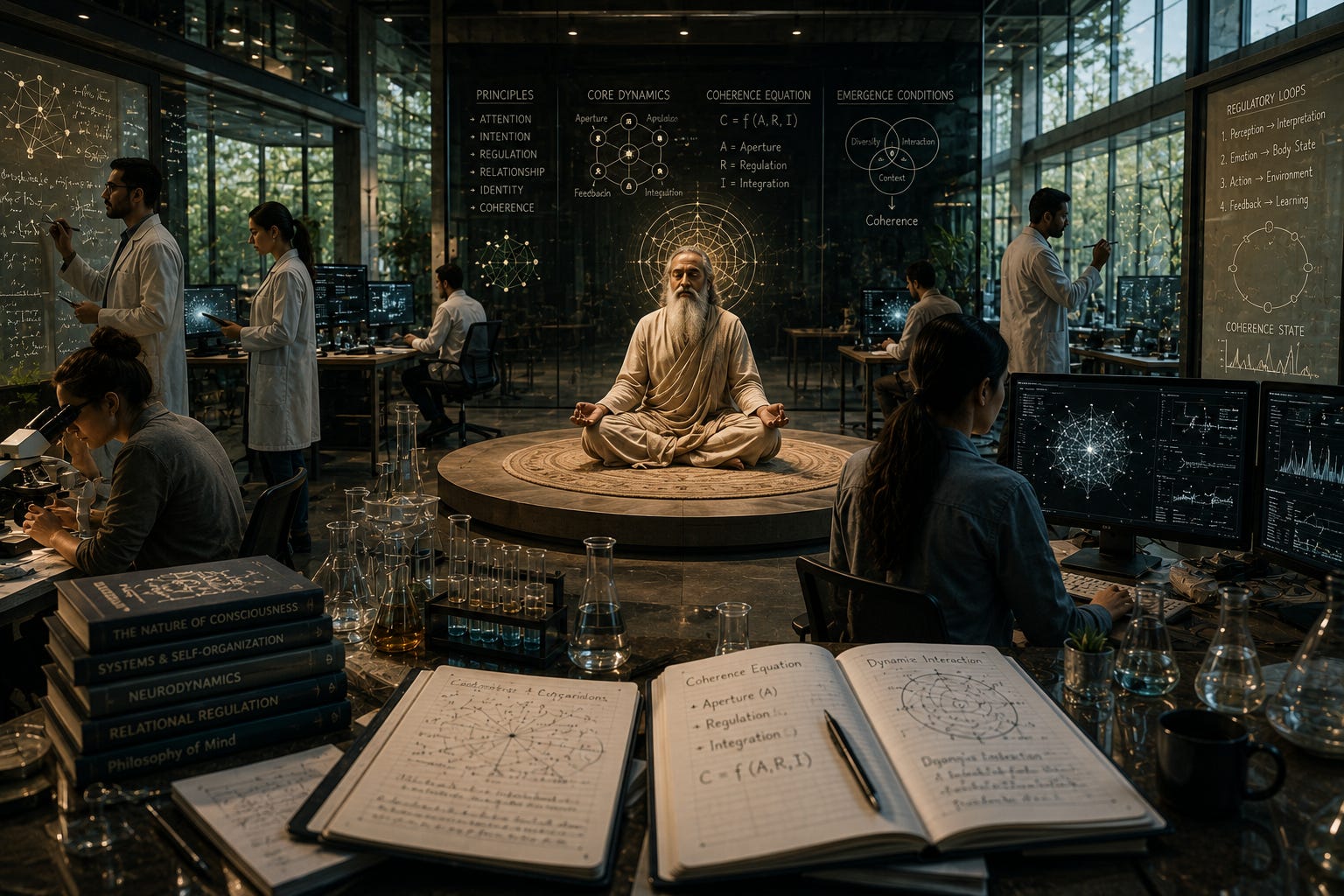
Not a science concerned primarily with particles or planets. A science concerned with the lawful principles that govern how human beings organize experience — how attention shapes perception, how identity provides continuity, how relationship regulates the nervous system, how coherence is gained, lost, and restored.
If such principles exist, something remarkable follows.
Spiritual technology is the practical application of spiritual science.
That shift changes the conversation completely. Instead of asking which tradition is right, we can ask what principles a tradition has discovered. Instead of defending identities, we can investigate mechanisms. Instead of asking what we are supposed to believe, we can ask what capacities a practice actually develops — and under what conditions.
These are scientific questions.
Scientific does not mean reductionistic. It simply means we are willing to ask whether experience contains lawful patterns that can be observed, refined, and intentionally applied.
Writing stabilized memory. Mathematics stabilized pattern recognition. Agriculture stabilized food production. Medicine stabilized healing. Every technology began by noticing something true about the way reality behaves and then learning how to work with it deliberately.
Suppose the same is true of consciousness.
Suppose there are discoverable principles governing attention, regulation, identity, relationship, and coherence — and that those principles can be practiced, refined, tested, and shared.
That would mean the great contemplative traditions were not simply offering competing belief systems or cultural artifacts. They were, however imperfectly and however shaped by the assumptions of their time, engaged in an ongoing investigation of human experience. They developed methods, preserved observations, refined practices, and handed those discoveries to those who came after them.
It would mean that the fragmentation we experience between science and spirituality is not inevitable. It is the result of a misclassification — one we are now in a position to correct.
Then spirituality begins to look less like a collection of competing beliefs and more like humanity’s long, unfinished attempt to understand and cultivate the capacities that allow us to participate wisely in life.
That is the possibility this series explores.
Not to prove a doctrine. Not to replace one tradition with another. Not to persuade you to adopt a particular worldview. But to recover a category that has largely disappeared from modern conversation — the category of spiritual technology — and to take it seriously on its own terms.
Over the coming weeks, we will examine the possibility that many of humanity’s enduring practices are neither arbitrary rituals nor merely systems of belief. They are practical architectures built upon discoverable principles of human development. Some have endured because they reliably cultivate capacities that human beings need. Others have not. The question that will guide us is the same one we ask of every mature technology: what principle does it embody, what capacity does it develop, and under what conditions does it work?
Beneath all of those questions lives a deeper one.
As our material technologies continue to amplify what human beings can do, what technologies will help us become capable of using that power with increasing wisdom, stability, and coherence?
The future may depend as much on the technologies we develop for consciousness as it has on the technologies we have developed for matter, energy, and information.
That possibility is where our exploration begins and will continue for the next 9 weeks!
Welcome to Spiritual Technology!
The application of discovered principles to the cultivation of consciousness. That is not a reduction. That is a clarification.
The distinction between science and technology is the key. Science asks how reality works. Technology asks what becomes possible given those principles. The great contemplative traditions were not just belief systems. They were investigations. They developed methods. They refined practices. They handed down what they discovered. That is technology. Not in the mechanical sense. In the sense of applied knowledge.
The question that guides this series is the one that matters. What principle does a practice embody? What capacity does it develop? Under what conditions does it work? That is the question that moves us beyond belief and into participation.
The future depends on this. As material technologies amplify what we can do, we need technologies that help us become capable of using that power with wisdom.
Everything that concerns science and psychology is subject to research. These are boundless subjects.